
As we approach the 2000th anniversary of Jesus Christ’s resurrection it is time to ask:
What was Christianity meant to be?
“Be Holy as I am Holy” 1 Peter 1:16
“This is the message we have heard from Him and announce to you, that God is Light, and in Him there is no darkness at all.” 1 John 1:5
“We have come to know and have believed the love which God has for us. God is love, and the one who abides in love abides in God, and God abides in him.” 1 John 4:16

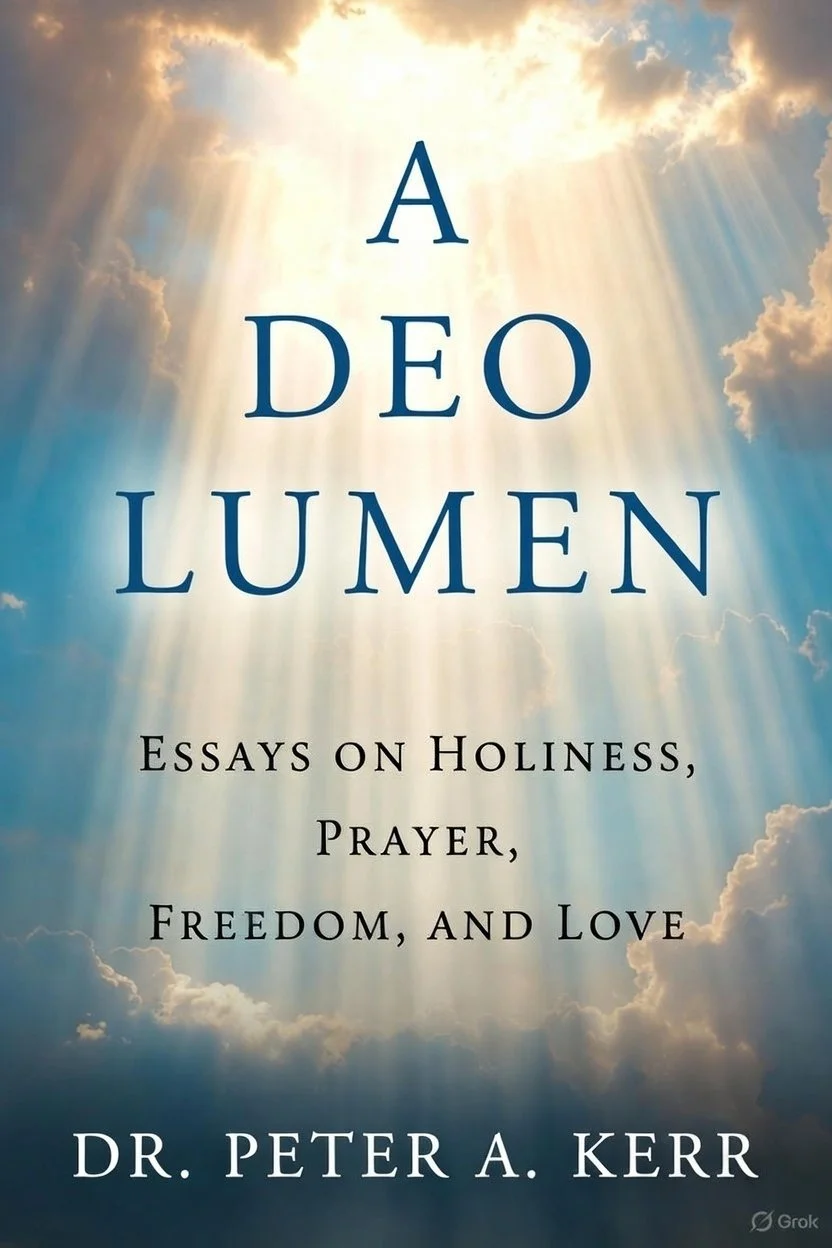
JUST RELEASED! New book
by Dr. Peter A. Kerr
Includes more than 40 Essays, many of them from this site slightly edited for clarity and integration of further thought, arranged and introduced in seven sections. Some of the new articles include:
Why Christianity Has Quietly Drifted into Control
Divine Partnership and Pedagogy: Why God Acts When we Pray
Dominion Granted Mankind: Impact on Authority, Earth, and Prayer
The Great Dance Behind All Things
Maturing in the Faith
Faith to do the Miraculous
Prayer and the Playground of Life
What LUMEN Is Not (and Why That Matters)
How God as Holy is at the Center
Why God Waits to Act
How This Theology Changed the Way I Pray…and Me
Why Holiness, Prayer, and Freedom Cannot Be Separated
An Invitation: Christianity the Way It Was Meant to Be
It is time to live and express Christianity as God intended.
This is not a new division or denomination. It is not a return to an idealized past, nor an over-spiritualized version of the gospel. It is simply a place where Christians of all backgrounds can gather to be enriched.
What is offered here is a careful reflection on God’s Good News—fully biblical, deeply shaped by the Early Church Fathers, and attentive to modern insight—so that the Light of the world, Jesus Christ, may be seen in all His radiance.
This is mere Christianity. At its heart is the sure vision: God is holy. He created out of an abundance of Goodness, Truth, and Love. His intimate love moves outward in breadth, inviting relationship, while His redeeming love moves downward in depth, meeting us where we are. Nothing we do can thwart that purpose, because it begins and ends in God.
You were made to be loved. (Jn 3:16)

A Christianity No One Need Fear
by Dr. Peter A. Kerr
For many thoughtful people Christianity has come to feel like something to brace against rather than something marvelous to behold. God is often presented as more severe than good, salvation more as rescue from divine anger than as entrance into divine life, and evangelism is too easily equated with pressure rather than invitation. Even when orthodoxy is sincerely defended, it can be communicated in ways that quietly train fear, compliance, or defensive anger rather than trust.
This is not how Christianity began.
As we approach the two-thousandth anniversary of the resurrection of Jesus Christ, it is worth asking whether the faith that once spread through beauty, truth, and love has gradually been burdened with postures that obscure its heart. The LUMEN project exists because of this question. It seeks to describe Christianity the way it was meant to be—not by inventing something new, but by seeing again what has always been there.
In this light, Christianity need not be feared—neither by other believers, nor by those of other faiths, nor even by convinced skeptics. It is not unitarian, nor ethically permissive, nor indifferent to truth. Yet it can be open, accessible, and genuinely conversational—more like an invitation to behold than a demand to comply.
Holiness Recovered as Love
We must recover holiness—not as severity or separation, but as fulsome, overflowing love. Scripture does not present holiness as God pulling away from creation, but as God’s goodness, truth, and love existing in perfect fullness and unity. God has nothing to prove. He does not create out of lack, rule out of insecurity, or redeem out of coercive necessity. He creates because love overflows. He invites because love respects freedom. And because God does not coerce, neither should anyone who claims to speak or act in His name.
This vision does not weaken ethics or soften truth. It deepens both. It insists that individuation matters, that freedom is beautiful, and that love—not fear—is the point of the entire Christian story.
A Grammar, Not a Splinter
LUMEN expressed on this website does not present itself as a new denomination, a corrective sect, or a theological rebellion. It does not ask Christians to abandon creeds, confessions, or historic commitments. It describes itself instead as a theological grammar—a way of speaking about God, Scripture, and Christian life that brings coherence to what the Church has always confessed but has often expressed anxiously or incoherently. Grammar does not add content. It orders meaning. It determines whether the same truths sound like invitation or threat, light or pressure.
Much of the fear surrounding Christianity today does not arise from its doctrines themselves, but from the grammatical assumptions that frame them. When holiness is imagined primarily as divine intolerance, power as control, and truth as domination, even orthodox claims can sound dangerous. When holiness is understood as fullness, power as self-giving love, and truth as light rather than force, those same doctrines are heard again as good news.
Because LUMEN is grammatical rather than sectarian, it is intentionally trans-traditional. It draws from Scripture, the early Church, and the great streams of Christian reflection without asking allegiance to a new camp. Its aim is not to rearrange Christianity, but to re-center it on the purpose of creation itself.
God Revealed in Christ
At the heart of this vision stands Jesus Christ. Many people fear Christianity because they have been taught—explicitly or implicitly—that God is divided within Himself: loving in intention but severe in nature, gracious in invitation but coercive in execution. Under such a picture, faith becomes risk management, obedience becomes self-protection, and worship becomes strategy. Christ reveals something entirely different.
In Jesus, God does not show a softer side of Himself. He shows His heart. The God who heals, teaches, forgives, and suffers rejection without retaliation is not a temporary accommodation. He is the clearest disclosure of who God eternally is. A God who is truly love does not need to overpower freedom to achieve His ends. Love that must be forced ceases to be love. Holiness that annihilates freedom ceases to be holy.
Evangelism as Invitation
If God is holy love rather than anxious authority, evangelism necessarily changes tone. It becomes invitation rather than coercion, witness rather than conquest, persuasion rather than pressure. The gospel is not an ultimatum delivered under threat. It is an unveiling of reality: God is good, God has always been good, and life aligned with that goodness is what creation was made for. Christian witness is not about managing outcomes God supposedly needs. It is about testifying, inviting, and trusting that truth does not require violence to be compelling.
Invitation does not mean indifference. It means conviction confident enough to respect freedom. Even judgment, in this grammar, is not God becoming hostile, but truth being brought fully into the light. What is resisted as threat under coercion can be received as healing under invitation.
LUMEN also re-centers a question that quietly shapes every theology: Why did God create at all? If creation exists to supply God with glory He lacks, fear will always haunt religious life. If creation exists primarily as a testing ground, suspicion will eclipse joy. Scripture instead presents creation as flowing from divine fullness, not divine need.
Seen this way, holiness is not restriction but alignment. Prayer is not leverage but communion. Ethics is not arbitrary command but formation into love. Salvation is not escape from embodiment but restoration to participation in what is most real.
Why No One Need Fear
A Christianity shaped by fear—fear of God, fear of outsiders, fear of questions, fear of freedom—cannot plausibly be good news. A Christianity grounded in holy love, confident enough to invite rather than compel, and faithful enough to stand within its own tradition without panic, has nothing to hide.
LUMEN does not ask skeptics to suspend reason or believers to silence conscience. It invites both to look again at Christ, to read Scripture without dread, and to consider whether the God revealed there is better than many have been taught to expect.
Christianity no one need fear is not a weakened faith but an invitation to sight. It is not a diluted gospel but truly Good News calling us to a relationship with God. It is a faith confident enough in God’s goodness to let love speak for itself—and strong enough to trust that love is, in the end, persuasive.
January 2026 Featured Article A Deo Lumen